

There are restaurants you visit and immediately feel that they could be so much more. For me, Po at The Warehouse Hotel has always been one of them.
I have always seen a lot of potential in Po — the beautiful heritage setting, its location along the Singapore River and, most importantly, its philosophy of celebrating the flavours we grew up with. So I was genuinely excited to hear that the restaurant was entering a new chapter, this time with Chef Fredric Goh at the helm and a much sharper focus on modern Peranakan cuisine.
Nearly a decade after Po first opened, its refreshed menu now centres on family recipes, regional ingredients and some lesser-seen Peranakan dishes, interpreted through Chef Fredric’s own cooking style.
And after tasting the new menu, I think this is exactly the direction Po needed.
From Cooking With Grandma to Becoming a Peranakan Chef
Chef Fredric’s relationship with Peranakan food goes back long before he became a professional chef.
He told us that he started cooking Peranakan food with his grandmother when he was just 14 years old. In school, he scored an A for Home Economics — although, as he jokingly recalled, English was quite another story.
Interestingly, he did not begin his professional career cooking Peranakan food. He started with Italian cuisine. His career has also taken him through kitchens including Forlino, The Lokal and Teepee Bar & Restaurant.
It was only when one of his head chefs asked him why he did not cook something he was naturally good at that he began looking seriously at the food he had grown up with. That eventually led him to Godmama Peranakan Restaurant, where he was chef-owner.

After eight years at Godmama, he joined The Warehouse Hotel in May and has since revamped Po’s menu, bringing his own interpretation of Peranakan cooking into the restaurant.
What I like is that he isn’t interested in changing Peranakan food until it becomes unrecognisable. His cooking is based on the recipes and flavours he remembers from his grandmother, but presented with his own techniques, textures and lighter finishes.
Familiar Flavours, But With Little Surprises
We eased into the meal with Po’s Classic Popiah ($32), a longstanding favourite that has remained on the refreshed menu. The filling is prepared fresh daily, hand-cut and slowly stewed and caramelised for four hours. Crispy pork lard and sakura ebi are added for extra crunch and umami.

I like that the filling is moist and naturally sweet. There is a nice contrast between the soft vegetables and crispy bits, and because you wrap it yourself, you can pile on as much filling and chilli as you like.


We also added the Crab and Pork Ngoh Hiang ($20), which turned out to be one of those dangerously easy-to-eat starters. It has everything I want in a good ngoh hiang — crispy on the outside, juicy within, with the water chestnuts providing that important crunch.
Then came the Bakwan Kepiting with Abalone ($15 per portion), traditionally a celebratory dish associated with Peranakan weddings and Chinese New Year reunions. Here, minced pork, snow crab and prawn are made into a filling and housed in a crab shell, accompanied by abalone in a light double-boiled broth with bamboo shoots.
Compared with the punchier dishes that followed, this was gentle and comforting. The broth was clean and light, allowing the natural sweetness of the seafood to come through.
The Two Dishes I Would Return For
The meal really took off for me when the Nasi Ulam ($28) arrived. This is Chef Fredric’s signature and easily one of my favourite dishes of the meal.


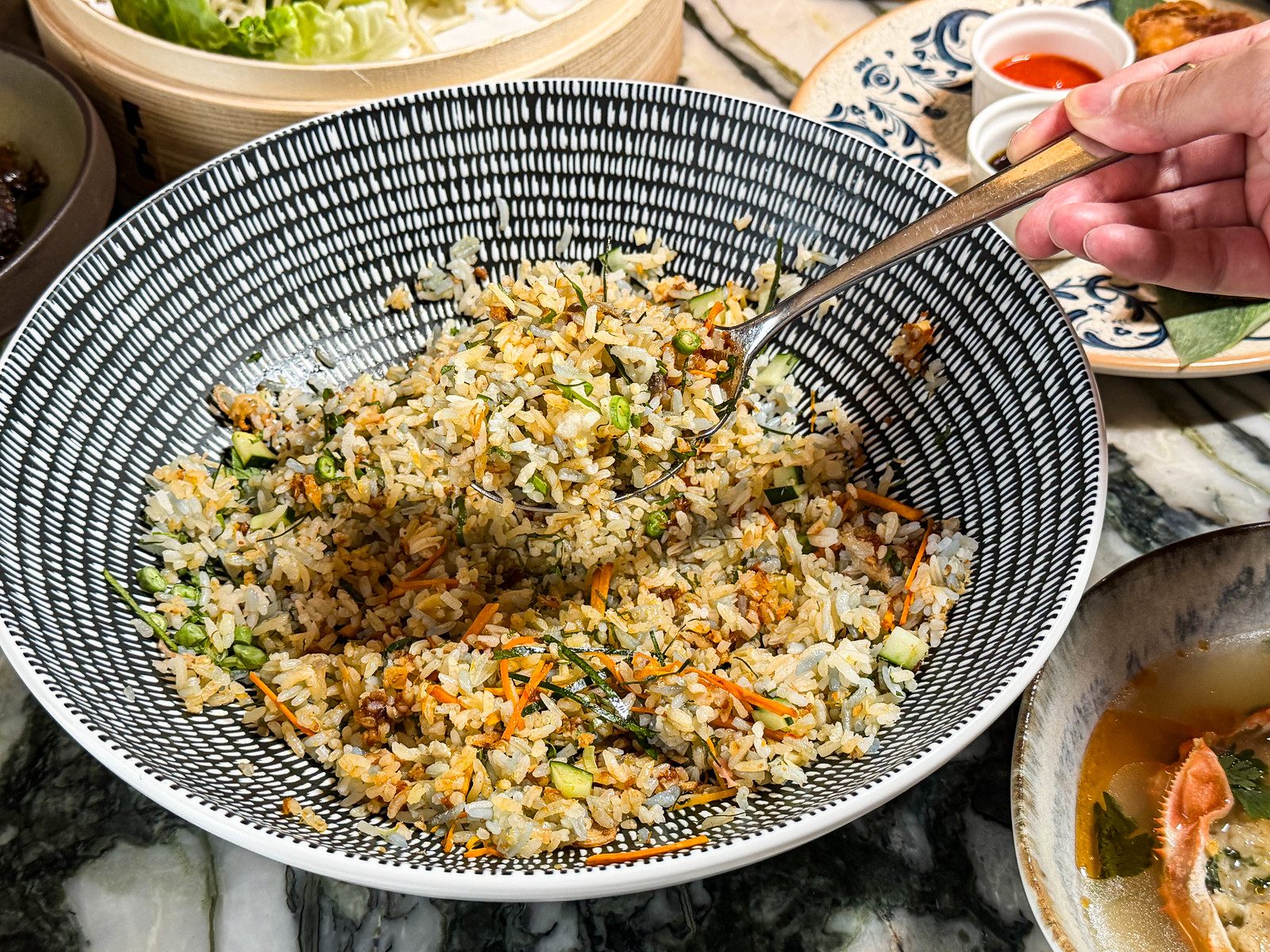
It looks deceptively simple, but nasi ulam is incredibly labour-intensive. Po’s rendition brings together 15 different herbs, spices and savoury toppings, individually prepared before being folded through fragrant blue pea coconut rice.
There is so much happening in every spoonful, yet somehow it doesn’t feel heavy or muddled. You get the freshness and fragrance of the herbs first, followed by coconut and layers of savouriness from ingredients such as shredded fish and dried seafood.
And please add the sambal. A little sambal wakes everything up immediately, giving the rice an extra punch of heat and savouriness. Every mouthful tastes slightly different depending on what lands on your spoon.
It is easy to understand why nasi ulam is increasingly difficult to find in restaurants. There is an enormous amount of preparation behind what appears to be a humble plate of rice.

The other dish I would definitely return for is the Buah Keluak Pork Jowl ($36). This one carries an even more personal story. Chef Fredric’s grandmother used to prepare buah keluak only once a year for Chinese New Year, and as a child, he would wake before sunrise on reunion eve to help her cook, carefully watching how she measured the ingredients from memory.
At Po, he pairs those flavours with succulent pork jowl, which has just the right amount of fat to stand up against the deep, earthy intensity of buah keluak.
The pork was tender and rich, but honestly, I couldn’t stop going for the gravy. It has that unmistakable nutty, slightly bitter complexity of buah keluak, and then Chef Fredric gives you something unexpected on the side — youtiao. Tear off a piece, dip it into the buah keluak gravy and let it soak everything up.
Wah. This one really shiok. It’s such a simple idea, but probably one of the things I remember most from the meal.
Bringing Lesser-Seen Peranakan Ingredients Back to the Table
Beyond the obvious crowd favourites, I appreciate that Chef Fredric has also made room for dishes and ingredients we don’t see as often in restaurants.


The Jantung Pisang ($24) features banana flower in a creamy coconut curry, served with tiger prawn. The banana flower has a slightly fibrous bite that absorbs the aromatic curry nicely, while the crispy element on top gives the otherwise soft dish some much-needed texture.
Even more surprising was the vegetarian Jackfruit Rendang ($22). Vegetarian rendang can sometimes feel like the meat has simply been removed and replaced, but this doesn’t.
Chef Fredric slowly caramelises the aromatics and spices to build the same depth and complexity associated with traditional rendang. The fibrous jackfruit works particularly well because it holds onto all that rempah, giving you plenty of flavour with every bite. We ate it with tempeh chips, which added a lovely nutty crunch. Even if nobody at the table is vegetarian, I would happily order this to share.
Desserts That Don’t Take Themselves Too Seriously

By this point, we were full, but the desserts were too interesting to skip.
The Chempedak Crème Brûlée ($14) has a smooth, creamy custard infused with the unmistakable fragrance of chempedak. I already knew I was going to like this before taking my first bite. Chempedak + crème brûlée. How to go wrong?
What works for me is that they haven’t tried to tame the fruit too much. You can actually smell and taste the chempedak, rather than getting a generic custard with a faint fruit flavour. Crack through the caramelised sugar and you get that lovely contrast of brittle caramel against the creamy custard. So funky and creamy!

The Pandan Panna Cotta with Coconut Brittle ($14) was the lighter alternative, bringing together familiar pandan and coconut flavours in a softer, more delicate dessert.
But the most playful has to be the Kueh Salat Ice Cream Sandwich ($12 for two pieces). Instead of reproducing kueh salat in its traditional form, Chef Fredric turns it into pandan ice cream folded with glutinous rice and sandwiches it between charcoal-grilled coconut love letter wafers. It looks nothing like kueh salat, but somehow your brain immediately recognises the flavours.
A More Exciting Direction for Po
And I think that sums up Chef Fredric’s approach to the new Po quite nicely.
This 35-year-old chef isn’t trying to make Peranakan food modern simply by making everything prettier. There is a personal story behind many of these dishes, whether it is the buah keluak he remembers cooking with his grandmother or the labour-intensive nasi ulam that he wants diners to rediscover.
There is also enough playfulness — youtiao with buah keluak, chempedak crème brûlée, kueh salat transformed into an ice cream sandwich — to make the meal interesting without losing sight of what the original flavours are supposed to be.
Po itself is named after “popo”, the Chinese word for grandmother, so Chef Fredric’s cooking and his memories of learning from his own grandmother feel particularly at home here.
I have always felt that Po had plenty of potential. With Chef Fredric bringing his own roots, memories and interpretation of Peranakan cuisine into the kitchen, this new chapter feels like a breath of fresh air for the restaurant.
The refreshed menu is available from 1 September 2026.
Po
Address: The Warehouse Hotel, 320 Havelock Road, Singapore 169628
Phone: +65 8971 3968
Opening Hours: 12pm to 10pm daily for lunch and dinner